Foster togetherness and growth of the Jewish Community in Eastern Uganda
Shalom (peace, respect and dignity), Tikkun olam (social justice and repairing the world), Chesed (kindness, compassion and generosity towards the needy), Tzedek (justice, sustainability and dignity) and Kavod (respect)
The Abayudaya congregation traces its heritage to the tribe of Judah. This community was founded by Semei Kakungulu, a British agent sent to conquer territories in Uganda. While reading the Bible, Kakungulu discovered the concept of monotheism, rejecting the Christian belief in the Trinity. As a result, he converted to Judaism.
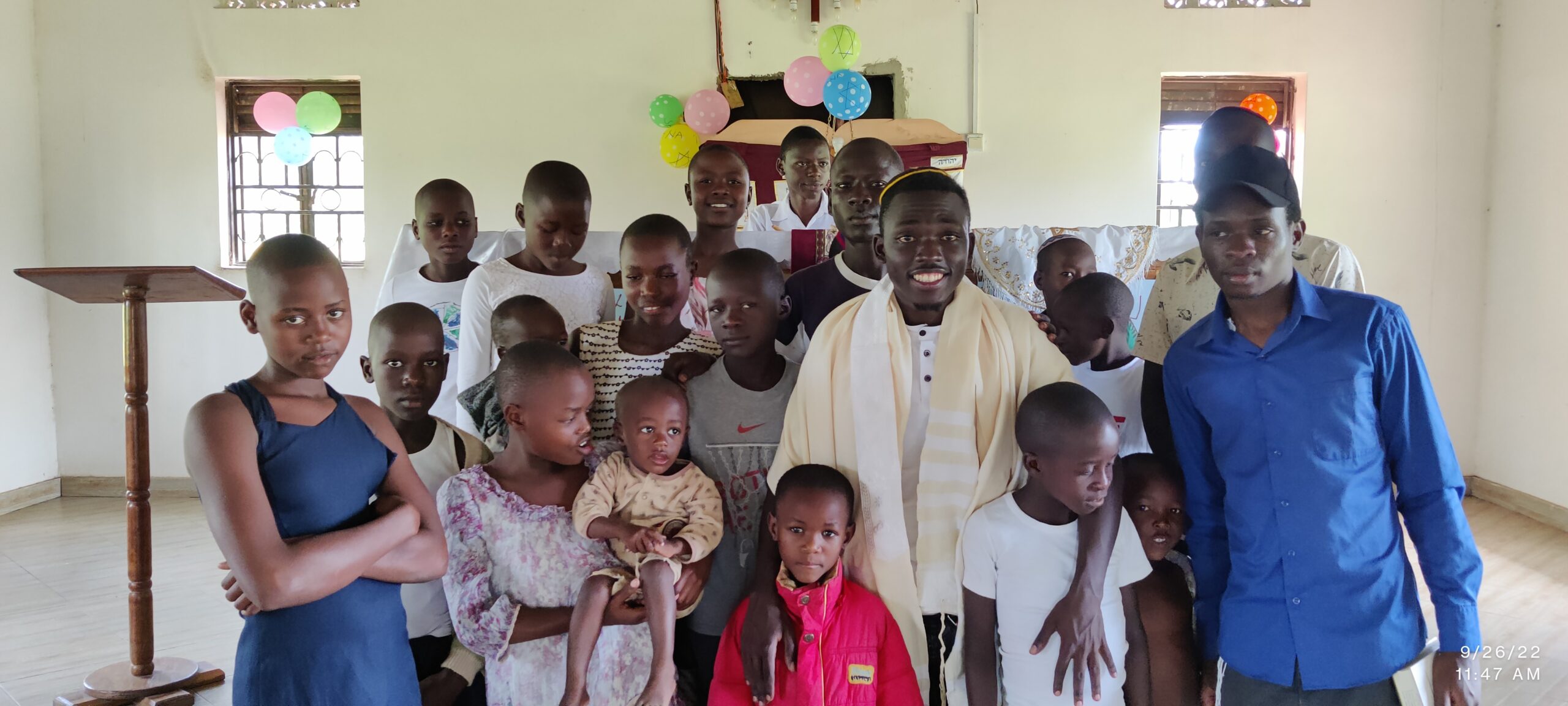
Using his political influence, Kakungulu ordered the chiefs within and beyond his palace to undergo circumcision. In 1919, he officially established the Abayudaya congregation as a religious community. He trained chiefs to lead prayers and conduct ceremonies in their local areas. Many synagogues were built under his leadership, including Namanyonyi, Nabugoye, Namakula, Nasenyi, Kabwangasi, Putti, and Namutumba, using his personal resources.
By 1928, when Kakungulu passed away, the Abayudaya population had grown to 3,000 followers. Despite limited formal education, community members diligently observed Jewish practices such as Shabbat, Jewish festivals, male circumcision on the eighth day, and other traditions.
The Impact of Idi Amin’s Regime
In 1971, Idi Amin’s dictatorship overthrew the Ugandan government and banned all religions outside Islam and Christianity, including Judaism. This period brought immense suffering to the Abayudaya. Synagogues were ordered to close or be destroyed, and members were arrested for openly practicing their faith. Out of fear for their lives, many converted to Islam or Christianity.
Jacob, an elder and chairman of Nasenyi Abayudaya Community, recalls, “One day, my father, a teacher at Nasenyi synagogue, was forbidden from burying a fellow member. We were chased away, and he fled for his safety. I hid in a swamp, and the body was left unburied without prayers.”
Some steadfast members continued practicing Judaism in secret, praying indoors with doors locked and someone watching outside. However, many traditions, including Shabbat observance, were abandoned. “We worked until Thursday, rested on Friday, worked on Saturday, and rested again on Sunday,” recalls Moses, a member of Nasenyi.
In 1979, after Idi Amin was overthrown, religious freedom was restored. By then, the Abayudaya population had drastically diminished.
Rebuilding the Community
In the 1980s, Abayudaya youth began visiting synagogues across Uganda to reconnect with members who had preserved their faith. Despite poor communication and transportation, their efforts over two years bore fruit.
In 1986, a general meeting at Nabugoye marked a turning point. The community’s name was changed from “Propagation of Judaism in Uganda” to “Abayudaya Congregation in Uganda,” and new leadership was elected. These leaders sought connections with other Jewish communities, eventually meeting American volunteers Matthew Mayer and Julie in Nairobi. These volunteers introduced the community to Kulanu, a U.S.-based nonprofit organization.
Kulanu’s Impact
Kulanu visited Uganda in 1995, breaking the community’s long-term isolation. With Kulanu’s help, the Abayudaya established an education fund, enabling members to attend high school and beyond. Gershom Sizomu, a prominent leader, later became a rabbi after training in an American rabbinical school.
In 2001, a group of rabbis conducted a Beit Din in Uganda, officially converting the Abayudaya congregation under the Conservative movement. Subsequently, some members affiliated with other Jewish denominations, such as Putti Synagogue with Orthodoxy and Namutumba with Reconstructionism.
Today, there are 15 synagogues in Uganda. Kulanu has supported the community by funding education, electrifying villages like Namanyonyi and Nabugoye, and providing clean water and schools.
Through these acts of service, generosity, and commitment, Jacob Mwosuko has stood as a pillar of Judaism within the Ugandan Jewish community, helping ensure that faith, learning, and communal solidarity continue to flourish for future generations.